The Sacred Lotus: A Plant Study
by Share Siwek
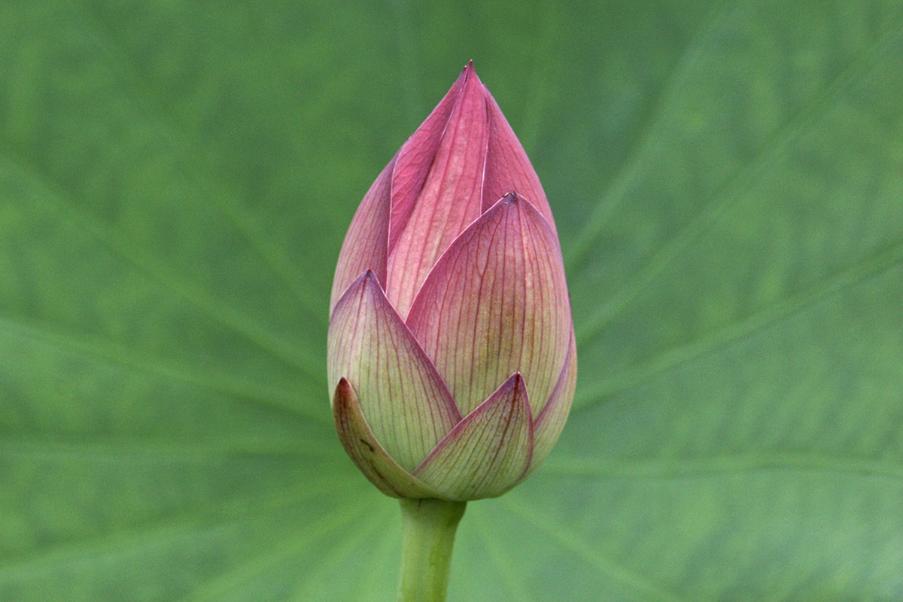
Editor's Note: The following plant study was submitted as part of the FES Practitioner Certification Program. The FES Plant Study Assignment is based on the Twelve Windows of Plant Perception. The purpose of plant study is to develop the practitioner's ability to integrate direct perception with imaginative understanding and assimilate external research within the context of direct experience of the plant. You can read other student plant studies here.
The Seen and Unseen World of the Lotus Plant
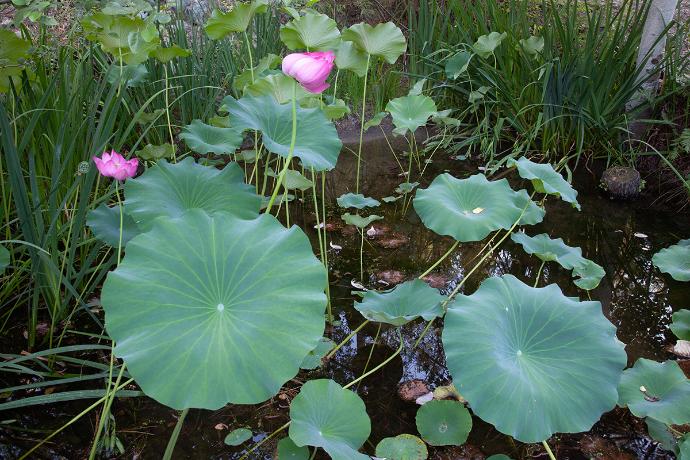
The tuberous roots were not visible beneath the mud, but I could see the shoots emerging from the mud and out of the water. Each individual stem of leaf and flower rises separately from the root/muck (group consciousness?). The stems are hollow but extremely tough on the outside, with small, rather pointed “dots” along the entire length of the stem.
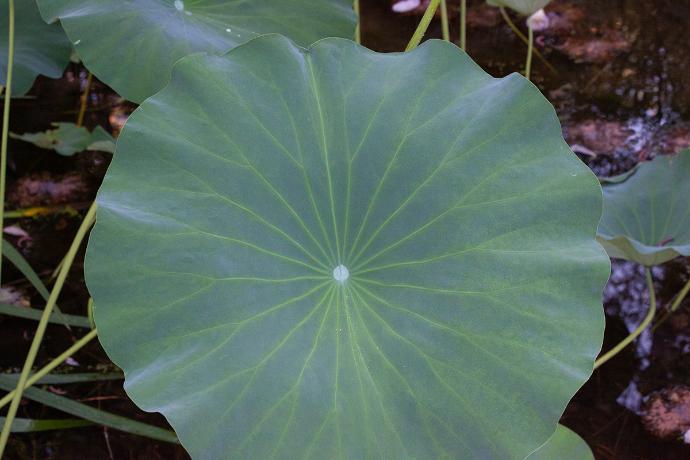
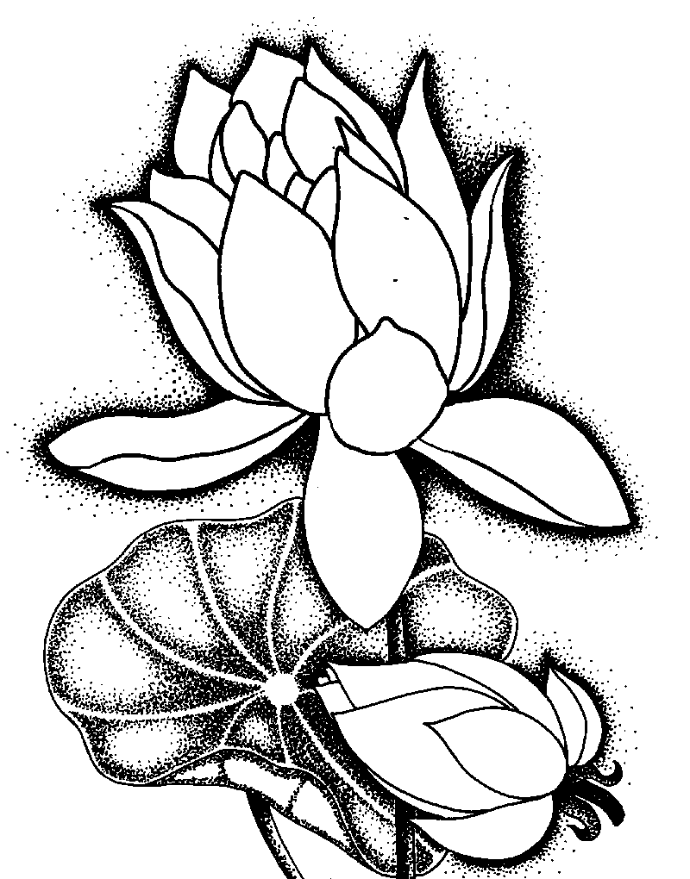
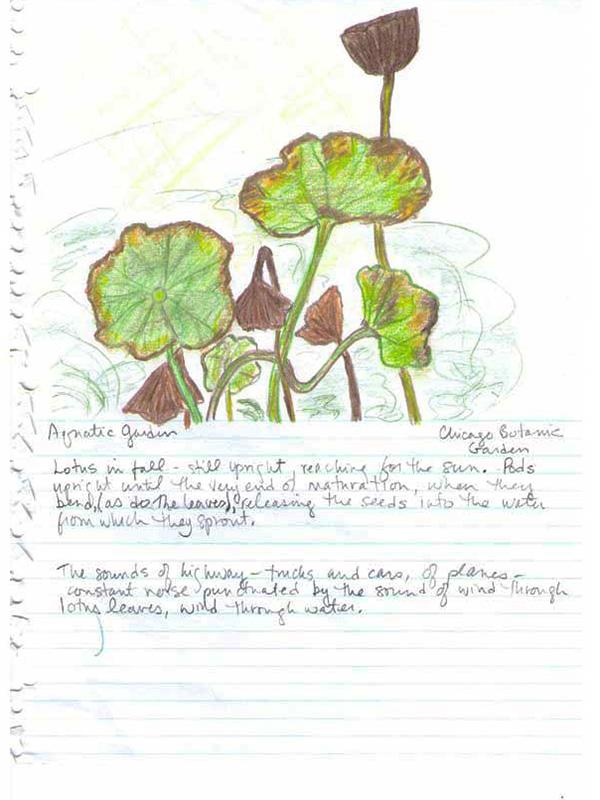
The leaves and flowers are borne high above the water’s surface, unlike those of the water lily, which float directly on the surface of the water. Initially, the leaves and flower buds are very pointy. The leaves are like tips of an arrowhead shooting up and unfurling into large, rounded, very broad cups. The cup-like leaves have a central “dot” which collects drops of water. This central, circular marking shows in the flower as well. Dew/water droplets also collect around the edges of the leaves and pods.
The leaf reminded me of a textile, very fibrous and tightly woven, one that would hold its shape for any number of purposes.
The leaves also have interesting veining, radiating out from the center
to the margins. It appeared that these veins were singular and straight
until very close to the edges, where they split off into usually only
one or two additional branches. On closer examination, I saw that the
entire leaf was “woven” with very subtle veins throughout the whole.
The
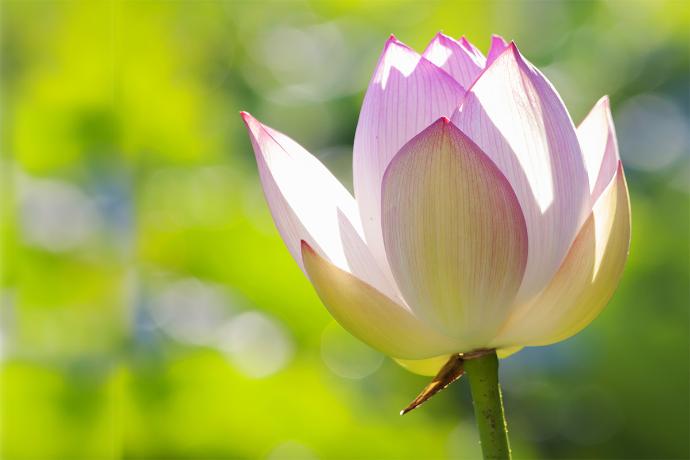
flower buds express the same tight, pointy quality as the leaves, and
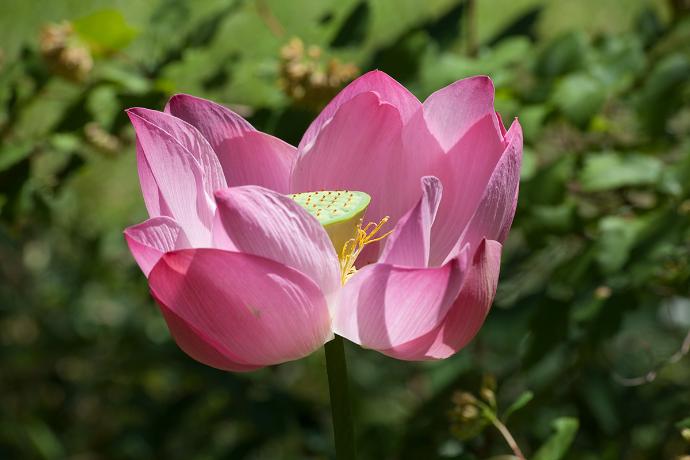
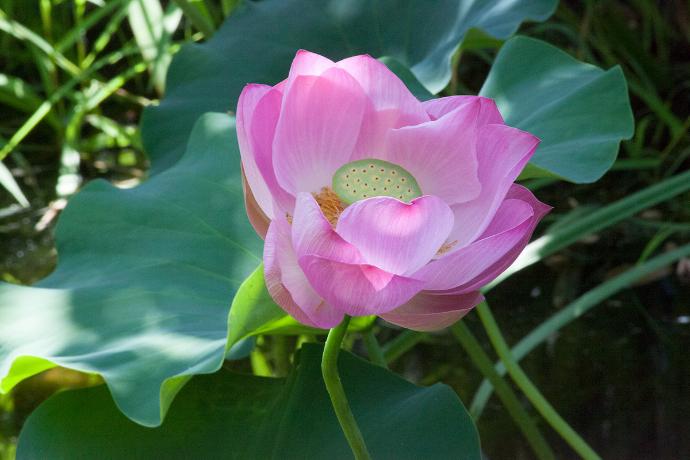
later also unfurl into a chalice-like multi-petaled blossom with a
central head or urn-like pod. The pointy buds are all green,
multi-layered, and tightly outlined, with no color initially. As the
flower bud begins to mature, it gets more relaxed, pinking up, but still
maintaining the tight symmetry of the upward pointing bud. The fully
opened blossom falls downward, away from the central cupule. When the
petals drop, the central pod enlarges and ripens, also expressing the
same shape as the flower. The flowers appear very delicate in relation
to the rest of the plant.
The roots are buried in the mud, and the stalks of the leaves and flowers are strongly attached to the root, resisting the tug of human hands to pull them out without cutting them. The stalks are also very fibrous, bending closer to the water as the stalk dries and the seeds mature. I did not observe any stalks that were actually broken off.
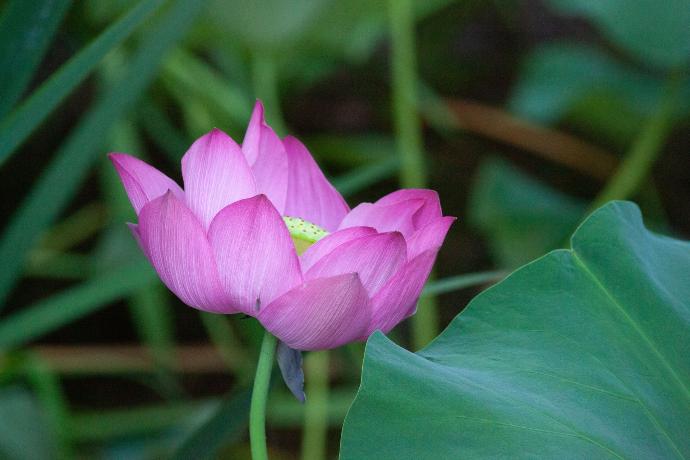
The flowers and the leaves all appeared to be reaching for the sun. The flowers closed in the late afternoon. I am not sure what time they open, but their motion definitely seems to be in relation to the sunshine. The leaves and pods remain upright, facing the sky, until they bend at some point in the stem when they are dying or ripening. Then these parts of the plant seem to return to the surface of the water, back into the depths and their roots.
The Lotus was very sturdy and well anchored. Although the flowers looked delicate, the petals were fairly substantial, at least to the touch. The strong stems of flowers and leaves were tubular and hollow, like conduits from the water upward.
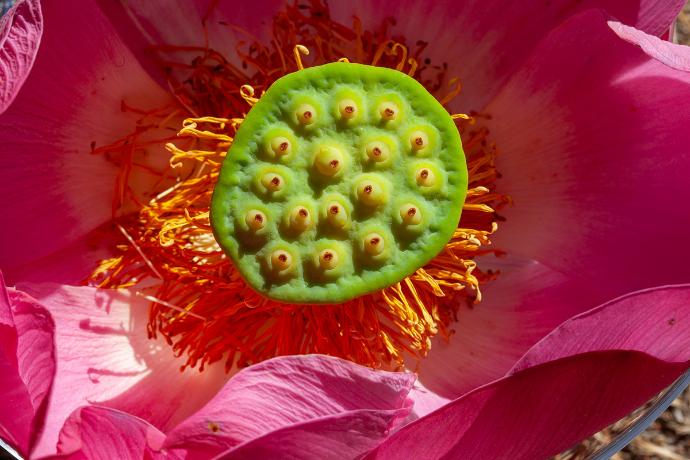
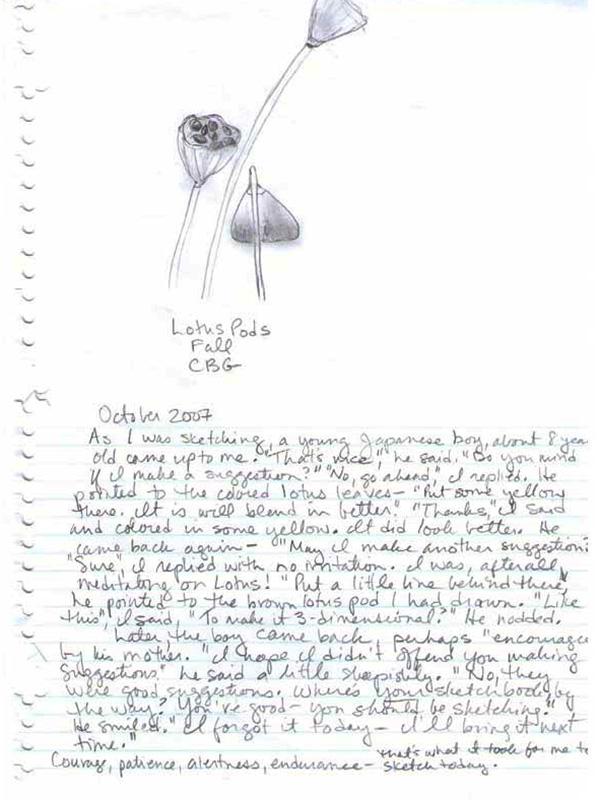
Each individual plant was not discernible to me, as many plants appeared to cluster together. Leaves, flowers, and pods appeared in random numbers on the pond and within the geometry of the plant. There was a lot of variation in the number of leaves, number of pods or number of seeds within each pod. I did observe that the seeds are arranged in a circle around the perimeter of the pod, with a variable odd or even number, surrounding the center seeds, which were also arranged in an odd or even number. The leaves occasionally had a bend or actual spiral in the stem, but the orientation for all remained upward.
The leaves, flowers and seed pods all have a similar signature: transforming from deep within to high in the air, then bending downward again and returning to the depths.
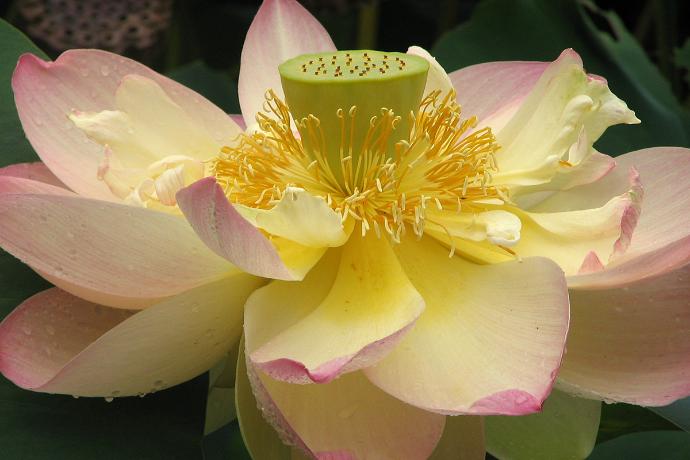
The pods/seed
heads contain the Lotus seeds within little circular chambers on the
flat surface of the top of the pod. These circles appeared to cradle the
seeds, which are round, within the pod until fully ripe. Both the
chamber of each seed and the seed itself got larger and larger until the
pod bent over to finally release the seeds into the water.
The
signature of the plant and the cycle appears to follow a circular or
even spiral path. The shape of the leaves and the flowers from bud to
seed head had a very similar look and feel.
Living with Other Beings in an Aquatic Environment
The Lotuses were surrounded by living creatures. The insects I observed were the dragonflies and mosquitoes, the latter especially this year in Illinois. In my home observations, I noticed many birds in my yard. The sparrows and smaller birds like finches perched on the edge of the tub my Lotus was growing in when I removed it to build the larger water garden. The birds drank from the water and cautiously bathed in it for the few days the Lotus was “dry-docked”.
Lotuses prefer the still water of lakes and ponds. They seem to need the mud to get a strong foothold. The Midwest is full of dense clay and tenacious mud. I’m not sure how these plants would do in sandy soil.
The Four Elements as They Appear in Lotus
The bright yellow center and surrounding bright pink petals makes the appearance of the Lotus reminiscent of a ring of fire.
Summer, or the season of Fire, is when the Lotus blossoms. In spring, and through the summer, the plant is vigorously growing, enjoying the warmth and humidity. The flowers open in response to sunlight, usually opening in the morning and closing in the afternoon. (This is not a direct observation; I did not see many flowers over the course of a full day). In fall, the Lotus leaves wither, the seeds within the pods ripen and eventually bend down to release the seeds. During winter, the plant sleeps beneath the water’s surface with dormant roots.
The plant has different degrees of hardiness, depending on the species and cultivar. The Illinois Lotuses are hardy to Zone 5.
Twelve Windows Through Which to View the Lotus
Form, Gesture, Signature
Botanical Plant Families
• Kingdom: Plantae—Plants
• Subkingdom: Tracheobionta—Vascular plants
• Superdivision: Spermatophyta—Seed plants
• Division: Magnoliophyta—Flowering plants
• Class: Magnoliopsida—Dicotyledons
• Subclass: Magnolidae
• Order: Nymphaeales
• Family: Nelumbonaceae—Lotus-Lily family
• Genus: Nelumbo—Lotus
• Species: Nelumbo nucifera—Sacred Lotus
It was interesting to read on the USDA plant website that the wild Nelumbo lutea
is found in 30 states in the USA yet is listed as a “noxious weed” in
46 states. Further tidbits included: banned in Connecticut, listed as
threatened in Michigan, listed as endangered in New Jersey and
Pennsylvania. That started my thoughts wondering what the indigenous
people may have used the wild Lotus for, and did it have properties
similar to the Nelumbo nucifera?
Nelumbo nucifera
is native to southern Asia and Australia and was introduced to Europe in
1787 as a “stove house water lily” by Joseph Banks. Ancient Egyptians
worshipped the blue water lily, Nymphaea caerulea, as the “blue Lotus” or “sacred Lotus.” N. nucifera was introduced late in Egyptian history is now extremely rare or extinct in Africa in the wild. In its native habitats, N. nucifera
is widely naturalized. It is the national flower of Vietnam and India.
Many times, the term “Lotus” is applied to water lilies as well as the
true Lotuses, although their growing habits and uses are very different.
Nelumbo nucifera
is very large, vertically about 150 cm and spreading up to 3 meters
(which explains why I couldn’t discern individual plants). The flowers
can be up to 20 cm in diameter and the leaves 60 cm across.
Color
Fragrance
Biochemistry
Medicinal uses, herbal lore, folk wisdom
It is amazing that the medicine of the Lotus has been used for centuries in Asia and continues to be used in contemporary medicine virtually unchanged. The Lotus plant is said to have no fewer than seven different parts of medicinal use, often for different purposes.
The Lotus provides medicine and sustenance while retaining its sacred role in nourishing the spirit. Living in both the physical and spiritual worlds, it represents the highest expression of service on all planes of existence.
The traditional use of Lotus for treatment of diarrhea, fungal infections, fevers and skin conditions (such as leprosy and ringworm) are supported by Western scientific investigation. The latex sap found within the leaves, stems, and flowers has great anti-bacterial activity and has been used to treat sexually transmitted diseases such as gonorrhea and syphilis, as well as other bacterial infections. The astringent qualities of Lotus may be efficacious in treating hemorrhoids and dysentery. In folk medicine, the astringent qualities of the flowers make Lotus blossoms a frequent treatment for diarrhea and cholera. Western medical treatment using Lotus has been effective in certain kinds of diabetes and rheumatoid arthritis.
The following “folk wisdom” was noted in the Kew online papers:
Roots and Rhizomes: To treat smallpox, throat conditions, loss of skin pigmentation, coughs, diarrhea, and dysentery. Rhizomes boiled with sesame oil and rubbed on the head to cool the head, including the eyes.
Leaves and Stems: Prepared many ways to treat hemorrhoids (piles), leprosy, parasites and vomiting.
Various parts of the flower, including petals: For diarrhea, cholera, fever, liver conditions, bronchitis, skin eruptions, snakebites, and scorpion stings. Dried flowers are prepared into a syrup to treat coughs.
Fruits and seeds: To soothe inflamed mucous membranes, lower fever, and alleviate halitosis. Seeds taken orally with a rice wash for seven days can increase female fertility.
All parts of the plant—root, leaves, stems, flowers, seed pods, and
seeds—are used medicinally and also for food. The starchy root or
rhizome is eaten in China, India, Japan, and other parts of Asia as a
vegetable. The large leaves are used to wrap food and even the stamens
are dried to make into an herbal tea or tea additive. The seeds are
eaten raw or dried and popped like popcorn. In China, the seeds are also
boiled down into a paste to use for a sweet soup or combined with sugar
to make pastries such as the famous mooncakes. In India, the Lotus
seeds are called Phool Mukhana and used in cooking. The flower petals are sometimes used as a garnish and eaten. There was a reference to Nelumbo petapetala
used as a source of starchy diet for the Native Americans. The plant
may also be a source of food for wild animals in some regions.
The
flowers are given as a sacred offering in many Eastern temples and the
dried pods are used extensively for decoration and flower arrangements. A
thread made from the leaf stalks is used for making wicks for oil lamps
in temples. Cloth woven from this yarn is believed to cure many
ailments. I have a mala (string of prayer beads) made of Lotus seeds, which I began to wear when working on this project.
I found
references to the flower essence being given to animals to encourage
them to reach their highest potential. It is said to have one of the
highest vibrations of any flower. Thus, animals who are victims of abuse
or trauma, or those transitioning can benefit from the gentle action of
Lotus, rising out of the mud and transforming into Spirit.
Cosmic and Earthly Relationships
Lotus seeds can survive an incredibly long time and have remained viable for more than 1,000 years. The Lotus lives in the world, but is not of the world.
The Lotus loves the sun and opens to its warmth. When the flower matures, the seed pod encloses the seeds in a cup-like womb. When fully mature, the stalk bends to release the Lotus seeds back into the water, into the mud to be born again. The Lotus seeds can survive an incredibly long time in a dried-up body of water and have germinated and grown into plants after more than a thousand years of dormancy.
Mythology and Spiritual Symbolism
The Lotus is considered a sacred and divine flower in many religions, most notably Hinduism, Buddhism, and the Baha’i faith. The Lotus rises from the mud, untouched and clean, to open into a magnificent flower high in the air. The life cycle, stature, and perfection of the Lotus is perhaps the reason that it represents purity, peace, transcendence, enlightenment, rebirth, beauty, and fertility. The flowers open with the light of the sun and close with darkness. Each day is a new life, a new rebirth for the flower. The life cycles of the Lotus, both daily and seasonal, evoke how the human spirit unfolds: from humble beginnings in the mud to the blossoming of the soul in the ether and light.
A symbol of the promise for humankind to rise above the muddy “soup” of life, the Lotus rises and unfolds, as the awakening and blossoming of those sincere on their spiritual quest.
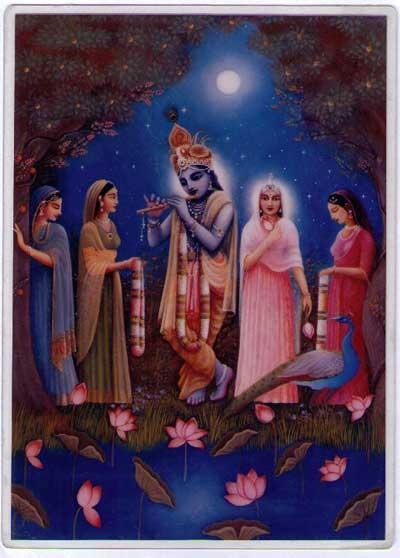
In Hindu creation mythology, the whole universe was at the end of days, engulfed in an ocean and timeless darkness after the “great deluge” (the flood and Noah’s Ark?). Vishnu, the preserver of life, was asleep in the primordial waters, dreaming of worlds to come. The Lotus flower emerged from his navel as his dreams unfolded. Brahma, the creator, was asleep within the Lotus flower. As Brahma stirred, creation began to unfold and new life appeared. That ancient world was also likened to “chaos” and our world was born through a “Golden Lotus,” the opening from the womb of the Universe. Many deities in Hinduism and Buddhism are depicted sitting on a Lotus blossom or carrying a Lotus in one of their many arms. The Buddha is said to sleep on a giant pink Lotus blossom six months of the year!
Ancient Egyptian mythology also alludes to Creation springing from a blue Lotus (actually a water lily, Nymphaea caerulea). The Lotus sprang from the primordial waters at the end of days, and the flower opened to reveal a new child god to restore the Light and dispel the Darkness.
It is told that when Gautma Buddha was born, he was able to walk fully upright minutes after birth and the Lotus blossoms sprang from the forest floor where he walked, thus foretelling of his divinity.
In Buddhist and Hindu symbology, the Lotus represents pure mind, bod, and speech, floating above the murky waters of attachment and desire. So it is believed that the heart can stay pure if the soul grows from the mud but does not partake of it. The Lotus is also a potent symbol of immortality and rebirth, as it can spring from the bottom of dried up pools after the rains.
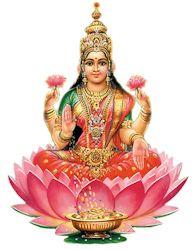
Nelumbo nucifera, the pink Lotus,
is the favorite flower of Lakshmi, the Goddess of Wealth and Prosperity.
It is said that in India, there is a race between the businessmen and
God each morning to procure the pink Lotus to offer to Lakshmi for
material abundance or for honoring and devotion at the temples. The pink
Lotus is said to also be a favorite of Brahma and used to describe the
beauty and perfection of Vishnu, the “Lotus-Eyed One” or the “One-Eyed
Lotus.”
The Indian literature also mentions the Lotus in
reference to sensuality, beauty, and lovemaking. Other names of the
Lotus include Padma, Kamla, and Kamalasana. In the Kamshastra (The Art of Lovemaking), the most beautiful and accomplished woman in this art is called the Padmini
(the Lotus Lady). In Vajrayana Buddhism, the union of the hard vajra
(thunderbolt) penetrates the soft, open Lotus and embodies the divine
embrace of compassion and wisdom. Lotus’ virtues span both the physical
and spiritual planes.
The Baha'i temple in New Delhi was designed in the form of a Lotus by the architect, Fariburz Sahaba. He said, “The Lotus not only has an association with all the religions of India but is probably the most perfect flower in the whole world. It is symmetrical, it is exquisitely beautiful. And how does it grow? It grows in a swamp, and it raises its head out of the slime absolutely clean and perfect. Now this is what the manifestation of God is in the world.” At night, it is said that the illuminated building appears to be floating on water.
Meditating on the Lotus is said to bring peace and stillness to our being, while the soul resides in the Lotus of the heart. Thus, the crown chakra cannot fully open without the heart opening as well.
Madame H.P. Blavatsky of the Theosophical Society spoke of the Lotus as a spiritual symbol in the late 1890s: “There are no ancient symbols, without a deep and philosophical meaning attached to them; their importance and significance increasing with their antiquity. Such is the LOTUS. It is the flower sacred to nature and her Gods, and represents the abstract and the Concrete Universes, standing as the emblem of the productive powers of both spiritual and physical nature.”
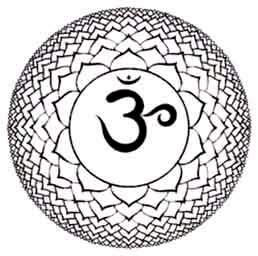
The chakras, or energy wheels, are depicted as variations of the Lotus. The crown chakra at the top of the head is called the “Thousand Petalled Lotus” and represents enlightenment. The gradual unfolding of the Lotus petals, one petal at a time, in response to the Sun, mirrors for us the awakening of our higher souls to self-realization or enlightenment.
In yoga, the “classic” meditation position is called padmasana or Lotus position. It is said to help keep the back straight for the transmission of energy through the spine and to help reach the highest level of consciousness. This symbolizes “reaching for pure knowledge while being rooted in the material world of experience.”
Lotus-Inspired Creativity
I saw a very shimmering quality around the Lotus, her aura, I believe. It was not sunny out, just a typical grey, overcast, Chicago-type day. The dew and droplets of water on the leaves and pods really sparkled, however. I can only liken this to the ether around the Lotus plant.
There was little wind, just a subtle breeze. The Lotus leaves and pods seemed to almost imperceptibly nod or sway with the breeze, silently. At the Chicago Botanic Garden, it was fairly windy and sunny; the leaves and pods of the Lotuses were rustling but effortlessly.
Here is what the Lotus said to me:
“Put your toes in the muck—dig in! Rise with strong stems from the waters of life. Unfold to greet the Sun. Let beauty be your reflection.”
I contemplated for a long time what the flower essence of Lotus meant for me. In the FES Professional Course notebook, the use of Lotus as an archetypal essence is not described until the Meta-Flora Level Seven, dealing with the higher realms of the spirit and soul work:
LOTUS—“To
facilitate the balanced development of the crown chakra, opening the
soul to the consciousness of higher worlds, but also helping the soul to
see the false spiritual ego, inflation, or illusion of grandeur.”
I began taking the Lotus essence about two weeks ago and this is what I understand about my spiritual growth right now:
We
are able to do our work here on the physical plane in a physical body.
If we were already self-realized, we would be in the ether, not of the
Earth. In order to attain that enlightenment, that self-realization, we
must come from the muck, the trials and tribulations of the earthly
life. It is only through the gifts of the body and being in the “soup”
of earthly existence that we come through the transcendence process of
uniting body, mind, and spirit and become whole. The key is to navigate
the waters, be nurtured by the Earth and the Sun, always looking upward
towards home.
Following is a message that came to me while traveling. It got my attention, as it came seemingly from “nowhere.”
Behold Lotus, out of the mud whose mighty leaves unfurl
Catching dewdrops like pools of glittering jewels with her embrace
Out of the mud I rise with buds and leaves tightly wound
To burst forth with color and form of delicate strength
Water
is life. The Lotus grows in the water but springs from the mud. The
signature of exquisite beauty from the muck of the primordial earth.
Signature is Earthbound reaching spiritually skyward.
Embodies
the four elements. Progression from earth/mud, through the water/life,
within its cycles the fire of transformation/leaves and flowers unfurl,
always reaching upwards towards the sky and sun into the air/ether of
the spiritual kingdom.
The Womb of the Lotus: An Original Parable
Up out of the muck Lotus must push strong stems. Her Mother does not cry as Lotus rises. This will always be home. So determined, so strong. No mud clings to her as she stretches forth. Up, up and now she knows what it is to feel with all her senses. She feels the air, the glorious lightness of air, so different from her earthly home. With glee, she opens her leaves, her arms, to embrace the air. She feels the breeze and the warmth. She basks in this warmth.
Lotus flower essence helps me to be in the world, open my heart to the world, and not drown in the soup. The essence has a very earthly quality, while balancing my desire to be “up there.”
Time passes and Lotus feels she will burst with joy. So she sends up a
shoot pointed straight towards the sky. So happy, so free, so peaceful.
As Lotus smiles, the bud bursts open, so lovely and still. This is a
greeting of love to Father Sun, an expression of natural perfection.
Later,
Lotus encloses her seeds, like her Mother, in a fleshy womb. She will
bend, not break, to send these seeds of her awakening back home to be
born again.
“Nothing dies,” her Mother whispers. “We only slumber to awaken and live again.”
(This was written in my backyard in Northbrook, IL)
About Share Siwek

Share Siwek’s love of flora and fauna led her to an undergraduate degree
in agriculture and then to the University of Missouri veterinary
college, where she received a traditional allopathic education. As a
classic "late bloomer," she practiced emergency medicine after
graduation in her early 30s. Seven-and-a-half years ago, she started a
holistic/integrative practice, Kindred Spirits Healing Arts, where she
was able to share her respect and admiration for the many gifts of the
plant kingdom with her patients and clients.
Share has used plant medicine in many forms including flower essences, herbs of all kinds, and essential oils. Her practice also incorporates acupuncture, bodywork such as massage and chiropractic, and Reiki and other energetic healing modalities. Currently, she is exploring the deeper aspects of flower essences and intuitive healing.
After work, she tends to the stewardship of a beautiful 1/2 acre of
Mother Earth in suburban Chicagoland, where she watches the miraculous
interaction of flora and fauna unfold each day. The garden includes many
trees, shrubs, perennials, grasses, water plants and many edible and
medicinal plants that the climate will allow.
Share attended the 2007 FES Professional Course.

To install this Web App in your iPhone/iPad press  and then Add to Home Screen.
